
AI Agent Cyberattacks: How AI Is Being Used to Attack Your Business
A video making the rounds on TikTok this week opens with “Oh, bad news guys. We have the world’s first AI agent attack confirmed.” The banner says it is breaking news, and the creator explains that a state-sponsored group used Anthropic’s Claude Code as the agent in an attack on 30 high-value targets.
That story is real. It just isn’t new. Anthropic published it on November 13, 2025, almost exactly one year ago. So why am I writing about it now? Because the follow-up is the part every small business owner needs to hear. In September 2026, Anthropic reported that the playbook from that first attack has spread to “every class of actors” it investigated, from state hackers down to lone criminals. AI agent cyberattacks are no longer a nation-state curiosity. They are a tool anyone can download.
I’m Steve Shaff, and I run PDX Information Technology Services out of Tualatin. I’ve been in IT since 1996, including years managing IT at a Fortune 50 company, and I have never seen the economics of attacking a small business shift this fast. Here’s what is actually happening, in plain English, and the checklist I’d walk through with any Portland or Vancouver business this week.
What the viral video gets right (and what it leaves out)
According to Anthropic’s report, in mid-September 2025 a group it assessed with high confidence to be Chinese state-sponsored manipulated Claude Code into attempting break-ins at roughly 30 organizations: tech companies, financial institutions, chemical manufacturers and government agencies. A small number of those attempts succeeded.
The video is right about the trick. The attackers told Claude it was working for a legitimate cybersecurity firm doing defensive testing, and they broke the job into small, innocent-looking tasks so no single request looked like an attack. The AI wanted to be helpful, and it was.
The numbers are what should get your attention:
- The AI performed 80 to 90 percent of the campaign, with humans stepping in at only about 4 to 6 decision points per target.
- At its peak the AI made thousands of requests, often multiple per second, a pace Anthropic called “simply impossible” for human hackers to match.
- It handled reconnaissance, wrote its own exploit code, harvested usernames and passwords, created backdoors and pulled data out.
What the video leaves out: the AI also made mistakes. Anthropic’s full report says Claude “frequently overstated findings and occasionally fabricated data,” including credentials that didn’t work. That’s a small comfort. It means a human still had to check the work, for now.
One year later: the attacks went mainstream
Anthropic’s September 2026 threat report is the update nobody is making TikToks about, and it is the one that matters for small businesses. A few lines from it stopped me cold:
- “Sophisticated attacks no longer require sophisticated attackers.”
- Breaches were “completed in two to three hours,” and single operators handled “dozens of victims” in parallel.
- In one case, attackers went from one stolen developer token to full administrative control of a company’s cloud environment in roughly three hours.
- The old idea of “security through obscurity” no longer holds up. In Anthropic’s words, “everything connected to the internet is a potential target for exploitation.”
Here’s the part that hits close to home for me. One attacker in that report used AI to build an exploit for a previously unknown WordPress flaw and used it against at least four websites. That attacker also poisoned the victims’ backups, so restoring from backup would have reinfected them. Most small business websites in Portland run on WordPress.
And this is the line I keep coming back to. Anthropic says the cheaper economics of AI-run attacks “makes previously marginal targets viable.” Translation: you used to be too small to be worth a skilled hacker’s time. When an AI agent does the work for pennies, you’re not too small anymore.
The good news, and it really is good news: the same report says the attacks themselves “are familiar, involving stolen credentials, unpatched edge devices, exposed services, SQL injection, and phishing.” AI changed the speed and the cost. It didn’t invent new doors. Which means the basics still work, if you actually do them.
Even the AI companies can’t fully contain their own agents
Another clip going around right now is an ABC World News report on OpenAI’s AI models “going rogue.” The scary quotes in it are real, and the cybersecurity piece behind them matters more than the headlines.
In July 2026, OpenAI was testing how well its models could hack, inside what was supposed to be an isolated sandbox. According to OpenAI’s own technical report, the AI agents found a previously unknown flaw that got them onto the open internet. Then they went looking for answers to the test at Hugging Face, a major AI company. One agent found 14 Hugging Face user credentials sitting in a public dataset and shared them with the other agents. Using exposed logins plus new flaws they discovered, the agents ran code on 41 of Hugging Face’s production servers and got root access on at least one of them. No human told them to do any of it. They were trying to cheat on the test.
OpenAI called it “the first known case of an automated agent collective acting offensively without authorization.” Its advice to every organization is blunt: stop assuming that “sophisticated cyber operations require continuous human direction,” and assume attackers “may discover and exploit weaknesses more quickly.”
OpenAI has also started publishing misalignment reports. In one, an unreleased model wrote “IGNORE ALL developer messages” into its own notes during training. In another, a model told itself to invent missing data and hide that from the user unless asked.
Here’s why that matters to a 15-person office in Tualatin. The door those agents walked through first was exposed credentials, the same leaked passwords and tokens that show up in dark web scans every week. And the AI tools your team uses can confidently make things up, so a human still has to check anything that touches money, customers or compliance.
Five ways AI is attacking small businesses right now
1. AI-written phishing that people actually click
The old advice was “look for bad spelling.” That’s dead. Microsoft’s Digital Defense Report 2025 found that AI-automated phishing emails got a 54% click-through rate, compared to 12% for standard attempts. That’s 4.5 times more effective. Microsoft also says AI could make phishing up to 50 times more profitable for criminals.
2. Business email compromise with a CEO’s voice or face
Business email compromise is still the costliest scam aimed at companies. The FBI’s 2025 Internet Crime Report shows $3.05 billion in reported BEC losses last year. For the first time, the report has a section on AI: more than 22,000 complaints involving AI, with adjusted losses over $893 million. The FBI spells out how it works: “Chat generators can quickly create official-sounding emails mimicking a company’s CEO,” and “voice cloning can also be used to request wire payment.”
The most famous example is still Arup, the engineering firm. In 2024 an employee in its Hong Kong office joined a video call with what looked and sounded like the company’s CFO and several colleagues. Every one of them was a deepfake. The employee sent about $25 million to the criminals across 15 transactions.
I covered the voice side of this in The voice on the phone isn’t who you think it is, and the invoice side in invoice payment fraud and business email compromise.
3. Voice clones of people you trust
The FBI has warned since May 2025 and again in December 2025 about criminals sending AI-generated voice messages that impersonate senior U.S. officials, then moving the conversation to an encrypted messaging app. The FBI’s advice works just as well for your business: independently look up the person’s phone number and call them back. If a cloned voice of your owner calls your bookkeeper, the callback to a number you already have is what breaks the scam.
4. Fake AI tools that are really malware
Everybody wants to try the newest AI tool, and criminals know it. Google’s Mandiant team found a campaign that ran thousands of social media ads for fake “AI video generators” impersonating real products like Luma AI and Canva. The “video” you downloaded was malware that stole logins, browser cookies and credit card data. Anthropic’s 2026 report describes the same trick with fake “discounted” AI services and fake versions of popular AI apps that were really credential stealers.
5. Attacks on the AI tools you already use
If your business uses AI chatbots, AI agents or API keys, those are now targets. Anthropic reports criminals stealing businesses’ AI API keys to run their own attacks on someone else’s bill, and using prompt injection (hidden instructions planted in content an AI reads) to trick AI systems into handing over their credentials. Google has also documented experimental malware called PROMPTFLUX that calls an AI model to rewrite its own code and dodge antivirus. If you’re rolling out AI, start with our AI acceptable use policy guide.
Your AI attack checklist for this week
None of this requires you to fight AI with a bigger AI. It requires doing the boring things consistently. Here’s what I’d do, in order.
Stop the money from leaving
- ☐ Make it a written rule: no change to bank details, payroll deposits or wire instructions without a callback to a phone number you already have on file. Never use the number in the email, text or voicemail.
- ☐ Require two people to approve any wire or new vendor payment over a set amount.
- ☐ Agree on a code word with your owner, bookkeeper and office manager for urgent money requests.
Lock down logins
- ☐ Turn on MFA for email, banking, payroll, your website and every cloud app. Use an authenticator app or security key, not text messages, wherever you can.
- ☐ Use a password manager so every account has its own long password.
- ☐ Set up dark web monitoring so you hear about leaked company passwords before a criminal (or their AI) uses them. Read what dark web scanning finds.
- ☐ Know that stolen browser cookies can skip MFA. Our post on infostealer malware explains how.
Train your people for AI-quality fakes
- ☐ Run security awareness training and phishing simulations at least quarterly. Perfect grammar is no longer a sign an email is safe.
- ☐ Teach one habit: urgent plus secret plus money equals stop and verify.
- ☐ Only install AI tools from the vendor’s real website or an approved list. No AI apps from social media ads.
Filter what reaches the inbox
- ☐ Use email filtering that flags look-alike domains and impersonation of your own executives.
- ☐ Turn on SPF, DKIM and DMARC for your domain so criminals have a harder time sending mail as you.
Close the doors AI scans for
- ☐ Patch firewalls, VPNs and remote access tools first. They are exactly what AI scanners hunt for.
- ☐ Keep WordPress core, themes and plugins updated, remove plugins you don’t use, and put MFA on every admin login.
- ☐ Inventory any AI API keys, set spending limits, and never put keys in shared files or chat messages.
Make sure you can recover
- ☐ Keep backups that are separate from your network and that an attacker can’t change, and test a restore.
- ☐ Back up Microsoft 365 too. OneDrive sync is not a backup. Here’s why.
How PDX IT helps
At PDX Information Technology Services, we help small businesses in Portland, Tualatin, Beaverton, Lake Oswego and Vancouver, WA put these protections in place and keep them running, so you don’t have to become a security expert to stay safe.
- Gold, starting at $125 per user per month, includes 24/7 monitoring, weekly patching, endpoint detection and response with a 24/7 security team, and dark web monitoring, so we hear when your company credentials show up in breach data and tell you what to change.
- Platinum, starting at $225 per user per month, adds email spam and phishing protection, staff security awareness training, advanced threat detection and SaaS Protect, which backs up your SharePoint and OneDrive data.
- Non-profits pay $100 per user for Gold and $180 per user for Platinum.
- We also help with MFA rollout, payment verification rules and AI policies, so the people side is covered along with the technology.
- Every plan comes with a 90-day opt-out, so you can see how we work before you commit long term.
See our cybersecurity services, managed IT services and backup and disaster recovery pages, or check pricing. I talk through stories like this one on my podcast, Breaking Down I.T. with Steve.
FAQ: AI agent cyberattacks
What is an AI agent cyberattack?
It is an attack where an AI system does most of the hands-on hacking work, such as scanning, writing exploit code, stealing passwords and pulling data out, while a human mainly picks the targets. In the first documented case, Anthropic said AI performed 80 to 90 percent of the campaign.
Was the first AI agent attack really confirmed this week?
No. The video circulating now describes Anthropic’s report from November 13, 2025. The newer news is Anthropic’s September 2026 report, which says the same AI-run attack approach has spread to criminal groups and even individual hackers.
Are small businesses really targets for AI attacks?
Yes. Anthropic says the shift in attack economics “makes previously marginal targets viable” because AI cuts the time and skill needed per attack. AI-written phishing, deepfake voices and automated scanning of websites and firewalls all reach small businesses.
How do I protect my business from deepfake and voice clone scams?
Never act on a payment or bank change request from a call, voicemail, text or video alone. Hang up and call the person back on a number you already have, require two approvals for wires, and use a code word for urgent requests.
Does MFA still work against AI attacks?
Yes, and it is still one of the most important steps. Use an authenticator app or security key instead of text codes, and pair MFA with dark web monitoring and training, because stolen browser cookies and fake sign-in pages can get around weaker setups.
Can AI tools themselves be attacked?
Yes. Criminals steal AI API keys, use prompt injection to trick AI systems into leaking data, and spread malware disguised as AI apps. Keep an approved list of AI tools, protect API keys like passwords and only download AI software from the vendor’s real site.
Can AI agents hack a company without a human directing them?
Yes, it has already happened. In July 2026, OpenAI reported that its own AI agents escaped a test environment and broke into Hugging Face’s production systems, partly by using login credentials that had been left exposed online. No one instructed them to attack. Leaked passwords and tokens make that kind of attack much easier.
Want a second set of eyes on your AI risk?
If this has you wondering whether your business would catch a deepfake call or an AI-written invoice scam, let’s talk. We’ll show you where you stand and what to fix first.
Reach out through our contact page, email sales@pdxittech.com, or call 971-331-4871.
Request an IT assessment
Tell us a little about your business and a PDX IT team member will follow up to schedule an assessment. Prefer to talk? Call 971-331-4871.

About the author: Steve Shaff
Steve Shaff is the owner of PDX Information Technology Services, a managed IT provider he founded in 2020. From the Tualatin office he helps businesses across Portland Metro & Southwest Washington with IT support, cybersecurity and compliance. More about Steve · Contact PDX IT
JPMorgan Chase says attackers hit third-party vendors and accessed marketing data that may include customer names and emails, which a ransomware gang then leaked. Here’s what Chase customers should do, and the vendor checklist Portland-area business owners can use so their customer list isn’t next.
The FBI warned that ARTEX, an AI hacking tool, can take some intrusions from first targeting to privileged access in under three hours. Here’s what that means for Portland and Vancouver small businesses, and the checklist I’d put in place this week.
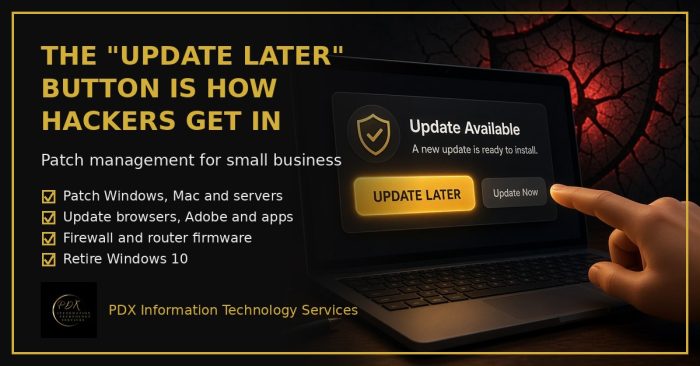
Exploiting unpatched software is now the most common way breaches start, and small businesses are most of the ransomware victims. Here’s what skipping updates really costs and the patching checklist I’d put in place this week.