
Hackers Attacking Exchange Servers In New Warning From Microsoft

Recently, Microsoft’s Defender ATP Research Team issued guidance relating to defending against attacks that target Exchange servers.
They are coming under increasing attack based on the latest Microsoft statistics, which show a marked increase in the use of web shells on on-premises Exchange servers.
The company is currently tracking multiple ongoing attacks, some of which are using fileless techniques. That adds an additional layer of complexity when it comes to detecting and preventing attacks.
According to the advisory issued by Microsoft, the recent campaigns:
“…exploit a remote code execution vulnerability affecting the underlying Internet Information Service (ISS) component of a target Exchange server.
…This is an attacker’s dream: directly landing on a server and, if the server has misconfigured access levels, gain system privileges…In many cases, after attackers gain access to an Exchange server, what follows is the deployment of web shell into one of the many web-accessible paths on the server.”
Web shells are versatile, highly customizable tools hackers deploy on compromised servers to not only gain, but also to maintain their access. They are used to remotely execute arbitrary commands and code, deliver a wide range of malicious payloads and to move laterally within the network to other devices.
Microsoft said that the most recent spate of attacks are specifically targeting vulnerabilities like CVE-2020-0688. If there’s a silver lining to be found, it lies in that there are already security patches available that protect against the most commonly used exploits in the recent string of attacks.
Unfortunately, those patches are unevenly applied across the Enterprise landscape, which leaves a significant percentage of corporate Exchange servers vulnerable to attack. Based on the latest company statistics released at the time this piece was written, although the patch has been available for some weeks, 82.5 percent of all Exchange servers were as yet unprotected. If yours is among that number, the fix is easy.
Request an IT assessment
Tell us a little about your business and a PDX IT team member will follow up to schedule an assessment. Prefer to talk? Call 971-331-4871.

About the author: Steve Shaff
Steve Shaff is the owner of PDX Information Technology Services, a managed IT provider he founded in 2020. From the Tualatin office he helps businesses across Portland Metro & Southwest Washington with IT support, cybersecurity and compliance. More about Steve · Contact PDX IT
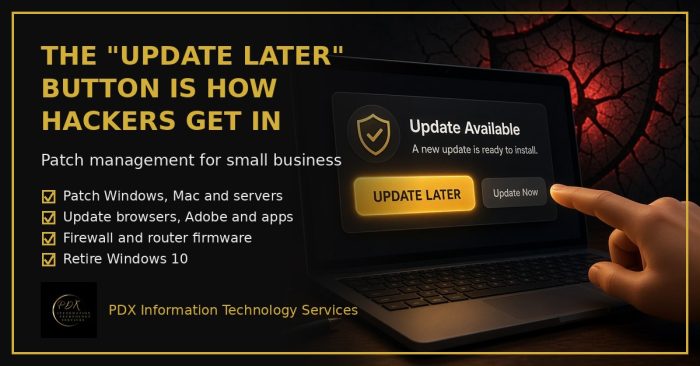
Exploiting unpatched software is now the most common way breaches start, and small businesses are most of the ransomware victims. Here’s what skipping updates really costs and the patching checklist I’d put in place this week.

The Vanguard data breach started when an imposter tricked an employee into giving up access, exposing files in cloud apps like Microsoft 365. Here’s what to do if you or your staff got a notice, and the checklist Portland-area business owners can use to stop the same social engineering trick.

A viral video says the first AI agent cyberattack was just confirmed. The real story is a year old, and the follow-up is worse: AI-run attacks have spread to ordinary criminals. Here’s how AI is being used against small businesses right now and the checklist I’d put in place this week.