
Cleverbridge data breach: what it means for your business
The Cleverbridge data breach is the kind of incident most business owners never hear about until a strange charge shows up on the company card. Cleverbridge is not a household name, but it quietly runs the checkout, billing and subscription systems for a long list of software and SaaS companies. If your business has bought or renewed software online, there is a fair chance one of those transactions ran through Cleverbridge.
On its incident update page, Cleverbridge says it detected unauthorized activity on November 4, 2026, and that “a third party copied a limited amount of personal data stored on our platform, including a small amount of payment card data.” It began notifying affected people on November 20.
I’m Steve Shaff, owner of PDX Information Technology Services in Tualatin. Here is what was reported, why it matters to a small business that never signed up for Cleverbridge directly, and the short checklist I’d walk through this week.
What happened in the Cleverbridge data breach
Here is what the public record says so far:
- November 4, 2026: Cleverbridge detected unauthorized activity, took affected systems offline to contain it, and brought them back online the same day.
- After that: its investigation found that a third party had copied data stored on the platform, including payment card data used to make purchases.
- November 20, 2026: Cleverbridge began notifying affected cardholders, using TransUnion’s Cyberscout to send notices and offer credit or identity monitoring where available.
- November 22, 2026: BleepingComputer published a notification letter stating the exposed data included the card number, expiration date and card security code (CVV/CVC).
Cleverbridge’s own FAQ says CVV data was involved “in a minority of cases.” It also says this was not ransomware and that none of its systems were encrypted. The notice BleepingComputer saw says no names, contact or billing details were copied.
What we still don’t know: how the attackers got in, how long they were inside, and how many people were affected. Cleverbridge has not said which of its software clients’ customers were involved. BleepingComputer notes that Cleverbridge lists brands such as Red Hat, SUSE, Tenable, Veeam, Jamf, Sony and Parallels as clients, but that does not mean those brands’ buyers were affected.
Why a stolen CVV matters
The three or four digits on the back of a card are what online stores use to check that the buyer actually has the card. A card number, expiration date and CVV together are enough for many card-not-present purchases. That is why the card industry treats the CVV as “sensitive authentication data.”
The PCI Security Standards Council is clear on this: PCI DSS Requirement 3.3.1.2 “strictly prohibits” storing card verification codes after authorization, even if they are encrypted. Cleverbridge has not explained why CVV data was available to be copied, and BleepingComputer says the company did not answer its questions about it.
What it means for your business
There are two sides to this one. First, your business may be a buyer. Office managers and owners often put software renewals on one company card and forget about them. If that card was used at a checkout run by Cleverbridge, it could be in the exposed data. The name on your statement may not match the software you bought, which is why Cleverbridge keeps a support page called “What is this charge from Cleverbridge?”
Second, the breach is a reminder for any business that takes cards. If your staff writes card numbers and security codes on paper, keeps them in a spreadsheet, or saves them in an email so they can “run it later,” you are holding exactly the data that PCI DSS says you must not keep. A small medical office, contractor or retailer in Tigard or Beaverton faces the same rule as a global payment platform.
Expect scams too. Cleverbridge warns people to be careful of unexpected emails, calls or texts about the incident and says it will never ask for card details, passwords or security codes that way. Criminals love a breach headline, so a fake “Cleverbridge refund” or “verify your card” message is a real possibility. This is where email filtering such as INKY and basic staff training earn their keep.
What to do now
- Check the mail. Look for a notice sent on Cleverbridge’s behalf by TransUnion/Cyberscout. Cleverbridge says those notices are legitimate.
- Review card statements. Go through recent statements for every company card used to buy software online, and report any charge you don’t recognize to the card issuer right away.
- Ask your bank about a new card. Cleverbridge suggests contacting your card issuer, who may decide to replace the card.
- Split up your software spending. If your bank offers virtual or vendor-specific card numbers, use them for subscriptions so one vendor’s breach doesn’t put every bill at risk.
- Never store a CVV. If you accept cards, use a hosted payment page or terminal from your processor and shred any paper card forms. Our compliance services can help you check your PCI setup.
- Warn your team. Tell staff that no real vendor will ask them to confirm card numbers or codes by email, text or phone.
The bigger lesson: your vendors hold your data
Like the recent JPMorgan Chase data breach, this one happened at a vendor, not at the business whose customers were hit. Your network can be locked down and you can still be exposed through a company you’ve never heard of that sits in the middle of a purchase. Good IT for a small business includes knowing which vendors have your card, your customer list and your logins, and keeping that list short.
That’s a big part of what our managed IT and cybersecurity services cover for businesses across Portland, Tualatin, Tigard, Beaverton and Vancouver, WA, including dark web monitoring that flags when your company’s credentials show up for sale.
Not sure where your company card and customer data are stored? Book a Free IT Security Assessment or call us at 971-331-4871. We’ll walk through your vendors, your payment process and your email defenses, and give you a plain-English list of what to fix first.
Request an IT assessment
Tell us a little about your business and a PDX IT team member will follow up to schedule an assessment. Prefer to talk? Call 971-331-4871.

About the author: Steve Shaff
Steve Shaff is the owner of PDX Information Technology Services, a managed IT provider he founded in 2020. From the Tualatin office he helps businesses across Portland Metro & Southwest Washington with IT support, cybersecurity and compliance. More about Steve · Contact PDX IT
JPMorgan Chase says attackers hit third-party vendors and accessed marketing data that may include customer names and emails, which a ransomware gang then leaked. Here’s what Chase customers should do, and the vendor checklist Portland-area business owners can use so their customer list isn’t next.
The FBI warned that ARTEX, an AI hacking tool, can take some intrusions from first targeting to privileged access in under three hours. Here’s what that means for Portland and Vancouver small businesses, and the checklist I’d put in place this week.
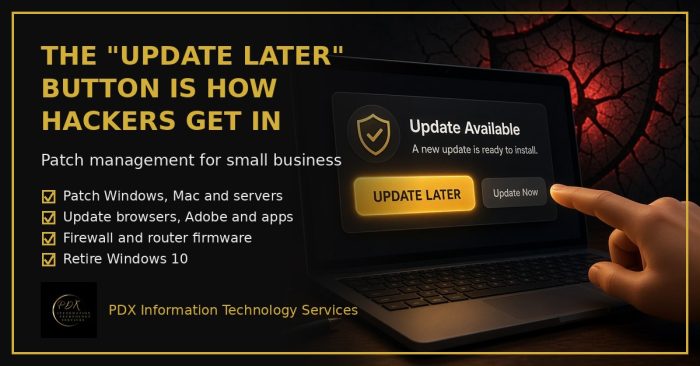
Exploiting unpatched software is now the most common way breaches start, and small businesses are most of the ransomware victims. Here’s what skipping updates really costs and the patching checklist I’d put in place this week.